I was working on this last month and it took me about a week to complete all the processing of images for this 20 page book.
It contains 36 images of mine from my trip to Kaziranga last year. I chose only 36 images to test the print quality and it looks good.
Some images I have designed for spread and some for the background. Overall I am quite happy with the quality of the print and looks quite promising to have few more such books of my earlier images! I am thinking...
If you want to have a look at it, you are welcome to knock my doors anytime. :)
BTW, you can view my all posts of my Kaziranga Trip HERE.
Cheers,
Ash
Showing posts with label Kaziranga 2009. Show all posts
Monday, July 5, 2010
Sunday, April 18, 2010
On the route for the last time
It was our final day in Kazi. The morning elephant ride was very fruitful. We had a wonderful experience of the misty morning which I wanted to have from the very first day. Now we were on our way to the Eastern Part of Kazi as our last safari.
On the way to the Eastern zone we had to cross paddy field area. Last time when we went there we had seen a big flock of parakeets resting on the tree beside the road. We were expecting the same flock to be present at that place as parakeets normally dont change their daily habits and routes.
For our surprise this time they were not on the trees but in the fields, busy in picking the paddy grains and other cereals. More and more were coming from various directions and joining the party. It was a sight to behold.
At one point of time there were nearly 500 birds in the flock. It was still growing. We all had a wonderful time photographing them. Shooting the flock to make good compositions is always a challenge for me. I think I have failed again! :(
If you were following all my posts of Kazi trip from the beginning you might be knowing that we had visited Eastern zone before as well. It is mixture of various types of habitats. It has woody region, it has lake bed, it has patch of grassland and it has river bed as well! So there are chances of seeing fauna in various types of habitats.
As we were heading towards the river bed, we noticed a huge tusker on the grassland beside a lake. It was quite huge and had very attractive long tusks. Kunwar declared that it will be coming to this part of the lake to cross the road where we were standing. We were a bit apprehensive on his declaration as we thought that it was too early to predict that. But that is Kunwar! He stopped the gypsy and told us to remain very silent, and he just slid onto his seat and closed his eyes as if he was preparing himself for a short sleep... ( in fact he was :) )
We were observing the huge guy. He slowly started showing the interest in coming to this side of the lake. He was trying to find a suitable place where he can cross the lake. After about 15 min, he was on this side of lake, beside which there was a road where our gypsy was standing. Kunwar then decided to move the gypsy a bit forward, to allow the tusker to cross. Doing this had another reason as well. The same guy had charged the previous day for one of the gypsies. As it is very difficult to escape in the reverse gear in case he starts charging from front, Kunwar proactively cleared the way for the tusker to cross the road. It was an intelligent move and that can come only by experience.
After about another 15min the tusker slowly climbed up to the road and there he was in front of us! He was a bit nervous and immediately crossed the road and disappeared into the woods on the other side.
As we moved ahead we saw a lonely elephant calf! The poor child was desperate to find its herd. The forest guard who was coming with us in the gypsy told us that the herd must have left this calf intentionally! We were surprised to hear that as we always thought elephant share a very complex and deep social bonding and are very protective about their calves. Guard told that this calf must have some disease because of which the herd must have abandoned it so that the disease will not spread to other calves in the herd! It was a totally new information for us!
The calf was looking very weak and it was roaming alone in the zone of tigers. Don't know what happened to that poor calf afterward.
We hit the grassland but the sun was already harsh. It was about 11:30AM when we decided to leave the place.
We came back to the resort, had our lunch, packed our stuffs and loaded them onto the Jeep to start towards another wonderland - Nameri.
See you there soon!
Cheers,
Ash
Tuesday, April 6, 2010
The morning mood of Kazi
So here I am with the report of our final day at Kazi. I have to explain it with the help of two posts because of two reasons. One, the images of morning elephant safari carries a totally different mood and I don't want to mix those images with the rest. Second, otherwise there will be quite a number of posts in a single blog post with very less words along with them. So I have decided to have two posts for the final day.
When I was planning for my Kaziranga Trip in the winter last year, the thing that I was dreaming about was that of an image where a Rhino will be grazing in the green grassland with a morning misty mood around. But on all the four days by the time we entered the National Park it was 7:30AM onwards with no mist around. We were also helpless because the Park opens only by 7.30AM! So I was terribly disappointed. What made me pissed off is when I came to know on the fourth day that the elephant safari starts at 5:30 in the morning and I have only 1 day to go for that. :( All the time I was thinking that the elephant safari also starts by 7:30AM as no one is allowed to enter the Park before that. But in truth the elephant safari takes a different route (obviously!) and it starts at 5:30AM! I had inquired with many people while making the tour plan but all the time I had forgot to ask this one information which proved me very dear!
So finally I was in the grassland in the wee hours of the morning and the atmosphere around was very misty and moody. I was overjoyed by the scene around and simply enjoyed it for quite some time.
Many people don't like shooting from elephant's back. The angle will be that much interesting and you cannot change the angle. It was first time for me to shoot from the back of an elephant.
It was a new experience and I was kind of liking it. In my images I made sure that I make the images of fairly distant objects with wide angle perspective so that the matter of angle can be eliminated as much as possible.
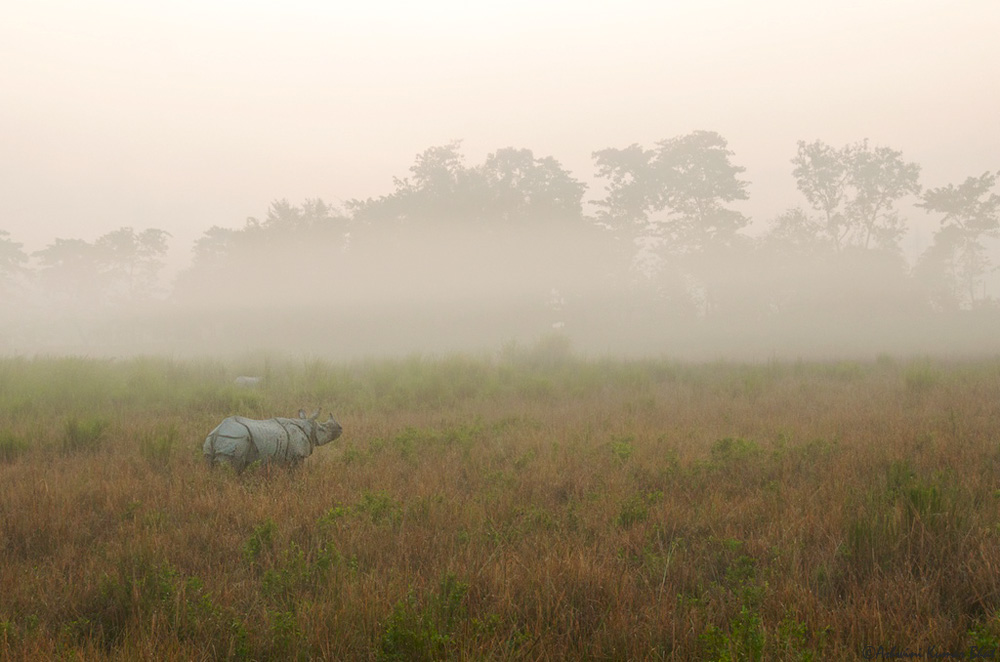
The sun was not yet there in the horizon and the moon was still dominating the sky. But the light of the dawn was already celebrating its presence. It was a very unique moody atmosphere that I experienced there. For my good fortune we found a rhino grazing calmly being oblivious to our presence.
The flocks of egrets and mynah had started to fly in the sky declaring that they can see the Sun at the horizon. Slowly the bluish mist started to become yellowish and within next 10-12min the golden light of the Sun was glowing everything around.
It was a wonderful moment. Enjoying the sunrise in the midst of elephant grassland is an amazing experience. The mahaut was very co-operative and told good stories of the elephant which was carrying us. They all call that lady as "Phoolan Devi" :). This is because all the rhinos are afraid of this lady and they normally don't come close to her, otherwise many a times rhinos charge elephants. Phoolan Devi's calf was following us all along and it was very funny and enjoyable seeing how happy that cute calf was.
I had always heard that how tall the elephant grass is but here on this day I really experienced it. It is virtually impossible to know what is there just a couple of feet away! To give you people a comparative perspective, in the below image the people are actually sitting on the back of an elephant and that elephant is no less huge! :)
Our ride ended at 6:30AM and I was very very satisfied with the way it went.
This is what I had imagined before planning the trip here and finally on the very last day it had come true - Kazi in the winter morning mood.
Cheers,
Ash
When I was planning for my Kaziranga Trip in the winter last year, the thing that I was dreaming about was that of an image where a Rhino will be grazing in the green grassland with a morning misty mood around. But on all the four days by the time we entered the National Park it was 7:30AM onwards with no mist around. We were also helpless because the Park opens only by 7.30AM! So I was terribly disappointed. What made me pissed off is when I came to know on the fourth day that the elephant safari starts at 5:30 in the morning and I have only 1 day to go for that. :( All the time I was thinking that the elephant safari also starts by 7:30AM as no one is allowed to enter the Park before that. But in truth the elephant safari takes a different route (obviously!) and it starts at 5:30AM! I had inquired with many people while making the tour plan but all the time I had forgot to ask this one information which proved me very dear!
So finally I was in the grassland in the wee hours of the morning and the atmosphere around was very misty and moody. I was overjoyed by the scene around and simply enjoyed it for quite some time.
Many people don't like shooting from elephant's back. The angle will be that much interesting and you cannot change the angle. It was first time for me to shoot from the back of an elephant.
It was a new experience and I was kind of liking it. In my images I made sure that I make the images of fairly distant objects with wide angle perspective so that the matter of angle can be eliminated as much as possible.
The sun was not yet there in the horizon and the moon was still dominating the sky. But the light of the dawn was already celebrating its presence. It was a very unique moody atmosphere that I experienced there. For my good fortune we found a rhino grazing calmly being oblivious to our presence.
The flocks of egrets and mynah had started to fly in the sky declaring that they can see the Sun at the horizon. Slowly the bluish mist started to become yellowish and within next 10-12min the golden light of the Sun was glowing everything around.
It was a wonderful moment. Enjoying the sunrise in the midst of elephant grassland is an amazing experience. The mahaut was very co-operative and told good stories of the elephant which was carrying us. They all call that lady as "Phoolan Devi" :). This is because all the rhinos are afraid of this lady and they normally don't come close to her, otherwise many a times rhinos charge elephants. Phoolan Devi's calf was following us all along and it was very funny and enjoyable seeing how happy that cute calf was.
I had always heard that how tall the elephant grass is but here on this day I really experienced it. It is virtually impossible to know what is there just a couple of feet away! To give you people a comparative perspective, in the below image the people are actually sitting on the back of an elephant and that elephant is no less huge! :)
Our ride ended at 6:30AM and I was very very satisfied with the way it went.
self in the front, Anush in the middle and Adithya U N in the back
This is what I had imagined before planning the trip here and finally on the very last day it had come true - Kazi in the winter morning mood.
Cheers,
Ash
Sunday, March 7, 2010
In the world of Gibbons
Gibbon WLS is at around 120kms from Kaziranga. From Kazi it takes around 2.5 hrs to reach this place. I highly recommend this place to have it as the must visit place if you plan a trip to Kazi. You will really get a very clear idea on how thick and fantastic forest was present in the North East before it was cleared for converting the land into tea gardens.
We left Wild Grass (resort where we stayed) at around 5.45 in the morning and we had Kunwar with us. That was a big relief for all of us as we had missed him in the last evening safari which had costed us a bit dearly. Kunwar is a great naturalist guide and an excellent driver as well. He has a really good knowledge about Gibbon Wildlife Sanctuary as well.
We stopped at Jorhat for a cup of 'Chai' and Gibbon WLS is quite near to Jorhat. Jorhat is a district place and it has a domestic airport. So to reach Kazi, one can plan to come to Jorhat via flight and then head to Kazi from here which is only couple of hours away. As we were near to the entrance of Gibbon WLS, Anush sighted Capped Langurs on the Acacia trees, grown along the border of a tea estate. There were around 3-4 of them.
Capped Langurs are found in NE India, Bhutan, Myanmar and China. They are found in the subtropical or tropical fry forests. They look very charming because of their golden colored fur and black face. The glittering eyes look amazing. We spent around 30min with this group before we started towards the entrance of the wild life sanctuary.
Gibbon WLS was earlier known as Hoollongapar Forest in the time of British. The Govt of Assam announced it as a Gibbon Wildlife Sanctuary in 1997. In 2004 it was again renamed as Hoollongapar Gibbon Wildlife Sanctuary.
Hoolocks rarely come on the forest floor. They are canopy dwellers. Most of their life they spend in the canopy. They need continuous stretch of forest canopy to move around in the jungle. The fragmentation of the forest and destruction of it for the tea estates along with the hunting has pushed this wonderful ape to get listed in the endangered species list.
Gibbon WLS is a wonderful place to see this ape. In the dense forest undergrowth you will see lot more creatures than just the Gibbons at the top. It is a wonderful place to observe some amazing bird species as well. I got a glimpse of one of the splendid birds that was high in my wish list - Sultan Tit.
I was thrilled when I saw this bird. Never in my dreams I had thought that I would see this here, though later I came to know that these are found here pretty often.
Finding the Hoolocks is a great joy in itself. But without a proper guide you may end up days together bt with no sight. The best way to trace them is waiting till they call out. Their sound is very distinct and they callout loud to and can be heard even kilometers away. They call to announce their territories and this is how all the groups in the jungle communicate as well. Normally they start calling at around 7 AM and till 11 AM. We hit our chance at around 9:30 AM when a guide from another group of photographers helped us to find the calling group. We ventured into the forest.
There was no pathways. It was very thick undergrowth and we had to make our ways to reach the source of the call. The forest was just pristine. There were plenty of leeches on the floor and the soil was wet. very less sunlight reaches the forest floor here. My eyes were at the canopy and finally after a chase of around 15 minutes we get to see a glimpse of the Gibbon - a female with a child clinging to it.
Gibbons are the only primates in which male and females have distinct colorations. Male is a dark black individual with prominent white eyebrow where as a female has more of a lighter colored fur. Their hands are very long, perfectly adapted to move around in the canopy. Another fantastic behavior is their hanging nature.
We spent around one hour inside the thick vegetation trying to catch the glimpses of its behaviors. Amazing feel it was. The forest was thick and as the sun was going up it was getting humid and more humid under the canopy. We finally came back to reach one of the main pathways after about one and a half hours inside the forest.
As we were about to leave the place, Kunwar sighted something very interesting. It was a Civet and that too on a tree!! Civets are mainly nocturnal and rarely found during the day and when found normally on ground. On a tree is something very special for all of us. It was basking in the sun to get itself warmer. A rare treat to all of us and another feather in the cap for Kunwar's sighting ability.
At around 1:00PM we were back in our Jeep, on the way to Kaziranga. We had our lunch at Jorhat and headed back to Wild Grass after that.
The next day was our final day at Kazi. Morning was our Elephant ride and we had decided to explore the Eastern zone after that as our final Safari.
And after that.....we would be heading to a national park which has the most beautiful landscape in all the National parks of Assam - Nameri....
Cheers,
Ash
Wednesday, February 17, 2010
Day 3: Day out at Burra Pahar
On the third day we head out to Burra Pahar (must be Buda Pahad in Hindi, means Old Mountain), a mountainous terrain with some dense forest habitat.
But for our bad luck, our Gypsy broke down on the way and we had to wait for about 30min until Kunwar got back with another Gypsy. But on the other side, for our good luck it had broken down in a nice place! Just beside the road there was Tea garden and a small village. As the Sun was just rising and the mist was still in the air the ambiance was excellent for some photo shoot.
All three of us enjoyed the morning Sun and the ambiance there. The people around were quite curious especially the children!
As our new Gypsy arrived, we continued on our path. On the way Kunwar amazingly sighted a Malayan Giant Squirrel. It was in quite a thick foliage but his remarkable ability to sight didn't fail to nail down the spot and we got some good images of this Near Threatened (according to IUCN) species of giant squirrels.
Burra Pahar is a thick forest range and the jeep trail runs on its almost the edge of the forest range. Its a place where not many tourists will enter due to relatively low sighting of Rhinos, for which Kazi is famous for. But this is the place to get a glimpse of the North Eastern forest and to feel its might. Many of the trees are broad leaved and tall. We saw plenty of bird activities on the canopy as well as under the canopy. I thoroughly enjoyed the feel of the forest. The mammal sighting was zero and after about 30min we reached a forest check post a watch tower, on the banks of the mighty river Brahmaputra.
After having out packed breakfast there, Kunwar took us along the bank of the river where the thick forest meets the river. Just as we were heading towards the river, the forest guard who had gone ahead came rushed and told us that he saw river dolphins! Wow! We all got excited and just ran to have a glimpse. River Dolphins are very active and its very difficult to track them, let alone photographing. I could see a river dolphin coming out over the water surface but only for a fraction of second and I will never know from where it will come out again! No photographers to attach to the story! But it was a great experience!
We headed along the river bank. There were River Lapwings and couple of Pied Kingfishers. On the far end there were good number of Great Thick-knees. The forest trail was buzzing with lots of verities of butterflies. Me, ignorant of their names always asking Anush if he could name few. Adithya was quite busy photographing them. Just as we moved ahead there was a clearance which was leading the river. There were elephant foot marks all around and Kunwar pointed to one area among the wet mud and held his finger steady.
It was a tiger pug mark! A huge pug mark! I was astonished to see the sheer size of it. Looking at it, he told that tiger had come there just last night or in the early morning. I was thrilled!
As we head further, we got some good photographic opportunities to shoot river lapwing and pied kingfishers.
We headed back to the point where we had our Gypsy by 10:30 and headed towards the grassland on the periphery of the forest region.
A part of the grassland was put under controlled fire to clear off the elephant grass and the weeds. Every year the grass of Kazi were burnt so that each year fresh grass can grow using the richer content left because of the burnt grass. the process had slowly started for the season from that part of the Sanctuary.
As we ventured into the grassland, within 10min we saw our first Rhino of the day. It was grazing in the dry grass. The sound of Gypsy alerted it and as Rhinos have poor sighting it just stood alerted in the direction from where the sound was coming.
After spending about 15min with it we moved on and near a water body we saw another Rhino grazing alongside of the pond standing in knee deep water. There were lesser whistling ducks in the pond and some Lesser Adjutant Storks were flying far away.
The day started getting hotter and we slowly started heading back. We needed to go back 30km to reach our hotel and should get prepared for the afternoon shoot as well. So we started our journey back.
Afternoon was planned in Western Region but the sad part for us was Kunwar was not with us. He had to go to repair his Gypsy if we want him for the rest of days. So he arranged another driver for us. the other driver was 'just a driver'. The sad part for all the three was that he was a typical 'tourist driver'. He was working in binary mode - stop or keep moving. He looked as if he didnot know something called 'slow approach or slow driving' which is very essential if you are taking photographers with you. We struggled quite a bit to get the Gypsy in place on many of the occasions to get our shots. We were missing Kunwar a lot. "Kunwar the incredible" (this is how Steve Winters has addressed him in his blog).
Finally after having a round in the Western Range we stopped at the Sunset point. But the Sun had already set by the time we reached there and there were couple of Black Necked Storks, some Egrets and few Herons standing in the red water.
There was a Rhino which came quite close to our vehicle and the forest guard made sure that it stayed a safe distance before it went on to do its business - grazing!
Overall the day was quite good. Burra Pahar certainly is a great place to enjoy. If you happen to sight wild animals its a bonus. But otherwise also its a wonderful place to visit. If you are a butterfly lover then there are plenty on the banks of the river, along the forest fringe.
At night there was another performance by the local people. The music and the dance were very nice. I enjoyed the whole time.
The plan for the next day was set - to visit Gibbon Wildlife Sanctuary, the place where you see the only ape of India - Hoolock Gibbons!
Watch out for my next post...
Cheers,
Ash
But for our bad luck, our Gypsy broke down on the way and we had to wait for about 30min until Kunwar got back with another Gypsy. But on the other side, for our good luck it had broken down in a nice place! Just beside the road there was Tea garden and a small village. As the Sun was just rising and the mist was still in the air the ambiance was excellent for some photo shoot.
All three of us enjoyed the morning Sun and the ambiance there. The people around were quite curious especially the children!
As our new Gypsy arrived, we continued on our path. On the way Kunwar amazingly sighted a Malayan Giant Squirrel. It was in quite a thick foliage but his remarkable ability to sight didn't fail to nail down the spot and we got some good images of this Near Threatened (according to IUCN) species of giant squirrels.
Burra Pahar is a thick forest range and the jeep trail runs on its almost the edge of the forest range. Its a place where not many tourists will enter due to relatively low sighting of Rhinos, for which Kazi is famous for. But this is the place to get a glimpse of the North Eastern forest and to feel its might. Many of the trees are broad leaved and tall. We saw plenty of bird activities on the canopy as well as under the canopy. I thoroughly enjoyed the feel of the forest. The mammal sighting was zero and after about 30min we reached a forest check post a watch tower, on the banks of the mighty river Brahmaputra.
After having out packed breakfast there, Kunwar took us along the bank of the river where the thick forest meets the river. Just as we were heading towards the river, the forest guard who had gone ahead came rushed and told us that he saw river dolphins! Wow! We all got excited and just ran to have a glimpse. River Dolphins are very active and its very difficult to track them, let alone photographing. I could see a river dolphin coming out over the water surface but only for a fraction of second and I will never know from where it will come out again! No photographers to attach to the story! But it was a great experience!
We headed along the river bank. There were River Lapwings and couple of Pied Kingfishers. On the far end there were good number of Great Thick-knees. The forest trail was buzzing with lots of verities of butterflies. Me, ignorant of their names always asking Anush if he could name few. Adithya was quite busy photographing them. Just as we moved ahead there was a clearance which was leading the river. There were elephant foot marks all around and Kunwar pointed to one area among the wet mud and held his finger steady.
It was a tiger pug mark! A huge pug mark! I was astonished to see the sheer size of it. Looking at it, he told that tiger had come there just last night or in the early morning. I was thrilled!
As we head further, we got some good photographic opportunities to shoot river lapwing and pied kingfishers.
We headed back to the point where we had our Gypsy by 10:30 and headed towards the grassland on the periphery of the forest region.
A part of the grassland was put under controlled fire to clear off the elephant grass and the weeds. Every year the grass of Kazi were burnt so that each year fresh grass can grow using the richer content left because of the burnt grass. the process had slowly started for the season from that part of the Sanctuary.
As we ventured into the grassland, within 10min we saw our first Rhino of the day. It was grazing in the dry grass. The sound of Gypsy alerted it and as Rhinos have poor sighting it just stood alerted in the direction from where the sound was coming.
After spending about 15min with it we moved on and near a water body we saw another Rhino grazing alongside of the pond standing in knee deep water. There were lesser whistling ducks in the pond and some Lesser Adjutant Storks were flying far away.
The day started getting hotter and we slowly started heading back. We needed to go back 30km to reach our hotel and should get prepared for the afternoon shoot as well. So we started our journey back.
Afternoon was planned in Western Region but the sad part for us was Kunwar was not with us. He had to go to repair his Gypsy if we want him for the rest of days. So he arranged another driver for us. the other driver was 'just a driver'. The sad part for all the three was that he was a typical 'tourist driver'. He was working in binary mode - stop or keep moving. He looked as if he didnot know something called 'slow approach or slow driving' which is very essential if you are taking photographers with you. We struggled quite a bit to get the Gypsy in place on many of the occasions to get our shots. We were missing Kunwar a lot. "Kunwar the incredible" (this is how Steve Winters has addressed him in his blog).
Finally after having a round in the Western Range we stopped at the Sunset point. But the Sun had already set by the time we reached there and there were couple of Black Necked Storks, some Egrets and few Herons standing in the red water.
There was a Rhino which came quite close to our vehicle and the forest guard made sure that it stayed a safe distance before it went on to do its business - grazing!
Overall the day was quite good. Burra Pahar certainly is a great place to enjoy. If you happen to sight wild animals its a bonus. But otherwise also its a wonderful place to visit. If you are a butterfly lover then there are plenty on the banks of the river, along the forest fringe.
At night there was another performance by the local people. The music and the dance were very nice. I enjoyed the whole time.
The plan for the next day was set - to visit Gibbon Wildlife Sanctuary, the place where you see the only ape of India - Hoolock Gibbons!
Watch out for my next post...
Cheers,
Ash
Subscribe to:
Posts (Atom)